









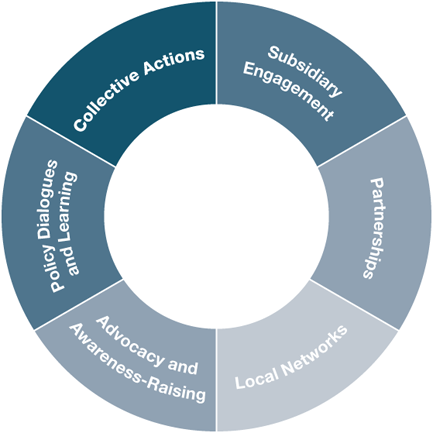
The Global Compact (UNGC) offers numerous action platforms for participant to demonstrate leadership on critical issues and advance the ten principles. Of course, companies joining the initiative are at different stages of their corporate citizenship journey. Small and large companies will therefore engage at different levels and implement the principles at different speeds. It is no surprise to occasionally see SMEs among the leaders, and large companies following. There are no expectations that engagement should follow a certain pattern or intensity, only that participating companies will engage and communicate. Companies can consider further engagement in six main areas and the Lead Initiative: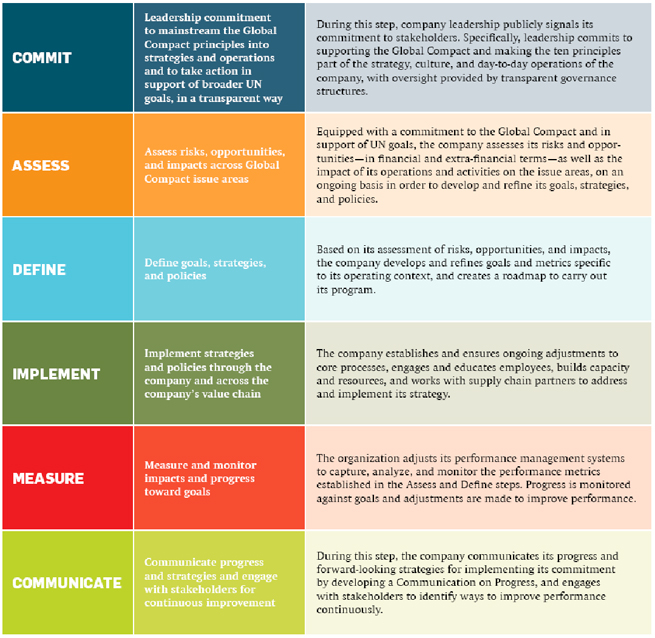
PARTNERSHIP
In addition to internalizing the ten principles, the Global Compact encourages participants to engage in partnerships with their stakeholders in support of broader development goals, such as the Millennium Development Goals. Together, these two complementary objectives – principles and partnerships – constitute the comprehensive model of good corporate citizenship promoted by the Global Compact. The basic concept of partnerships is simple and straightforward – to identify common ground between the private and the public sectors, and to combine their resources, skills and expertise to improve results. Partnerships focus on the many areas where private actors and public institutions can engage in win-win relationships, such as poverty reduction, health, education and community development. Cross-sector partnerships can make it possible to overcome challenges that are too difficult for one organization or sector to address alone, and can make efforts more effective by combining resources and competencies in innovative ways. Through collaboration, actors can strengthen their efforts to achieve individual objectives by leveraging, combining and capitalizing on complementary resources, strengths and capabilities.
There are three main types of partnerships:
- Advocacy and Policy Dialogue – Companies engage with other stakeholders to take a leadership role in championing, advocating for, and contributing to resolving different issues.
- Social Investment and Philanthropy – Companies provide financial support, contribute volunteers and/or expertise, or make in-kind contributions, including product donations.
- Core Business - Partners collaborate to create employment and foster entrepreneurship, contribute to economic growth, generate taxation revenues, implement social, environmental or ethical standards and provide appropriate and affordable goods and services.
Up
LOCAL NETWORKS
The Global Compact's Local Networks remain the most important vehicle for increasing and intensifying theimpact of the initiative – by providing on-the-ground support and capacity-building tied to different cultural needs. The Global Compact is genuinely global because it is local everywhere. Currently, Local Networks can be found in approximately 90 countries around the world. The primary function of Local Networks is to promote the Global Compact principles and facilitate their implementation by participants – both local firms and subsidiaries of foreign corporations. Networks undertake a variety of activities to do so, including identifying local priorities relating to responsible business, launching campaigns on different priority issues, organizing learning and dialogue events, disseminating local good practices, mobilizing collective action efforts, and broker partnership projects between companies and their stakeholders. In addition, Global Compact participants are also seeking the assistance of Local Networks to prepare their annual Communication on Progress. For more infos.
Up
ADVOCACY AND AWARNESS RAISING
As a signatory to the Global Compact, a company is expected to publicly advocate the Global Compact and its principles via press releases, speeches, and other communications vehicles. Advocacy does not have to take the form of lobbying or activism. Companies can demonstrate advocacy through screening and training their suppliers on respecting human rights and the related Global Compact principles. Publication and distribution of a Communication on Progress (COP) can reach numerous stakeholders with the universal value message of the Global Compact.
Companies are asked to embrace, support and enact the ten principles within their "sphere of influence". Perhaps the term is better described as spheres of influence, and envisioned as a series of concentric circles, where influence diminishes as the circles get bigger. The smallest circle includes a company's core business activities in the workplace and marketplace. This is where a company has the greatest control in affecting ESG (environmental, social and governance) performance. The next circle covers the supply chain. Control is weakened here, but in some cases the influence can be significant. The third circle includes a company's community interaction, social investment and philanthropy activities. And the final circle of influence is a company's engagement in public policy dialogue and advocacy activities.
Up
POLICY DIALOGUES AND LEARNING
Each year, a variety of Global Compact-related events are held around the world, designed to enable learning and the development of practical solutions to pressing problems. Policy dialogues and learning can take place at the local level organized by Local Networks, or at the regional or global level. Past international events have taken place in Brazil, India, China and Ghana. The Global Compact Office uses three primary tools for advancing learning and policy discussions.
Policy Dialogues: The dialogue process helps to identify new and emerging issues, promote multistakeholder trust and interaction, and support advocacy with policy makers. The meetings are an international platform for mutual understanding and problem-solving. Issues addressed have included "The Role of the Private Sector in Zones of Conflict", "Business and Sustainable Development", and most recently "Combating Discrimination and Promoting Equality in the Workplace".
Leaders summit: The Global Compact holds a triennial Leaders Summit that convenes top executives from participating businesses, heads of international labour, civil society and United Nations agencies, as well as high-ranking government officials to discuss both progress made and chart the future strategic course of the initiative. The Summit is chaired by the United Nations Secretary-General. Participants are encouraged to take part in dialogues and learning events to share experiences with others about challenges and dilemmas, and to contribute to the ongoing development of future material related to priority issues.
Up
COLLECTIVE ACTIONS
Companies can also choose to engage in collective action with other companies. Collective action can be an effective way of creating a level playing field on which to compete and increases the impact on local business practices beyond the capacity of any one company. Knowing that other companies in your sector or location are committed to good practices helps to build mutual confidence and supports behavioural changes. Joining forces with other companies can also contribute to identifying and developing innovative solutions to key challenges. Examples of some of the high-profile collective action initiatives that companies have recently engaged in include Caring for Climate: A Business Leadership Platform, the CEO Water Mandate, the Extractive Industries Transparency Initiative (EITI), the Publish What You Pay Initiative, the Global Business Initiative on Human Rights (GBI), or the Voluntary Principles on Security and Human Rights.
Up
SUBSIDIARY ENGAGEMENT
As a participant in the Global Compact, a company is expected to make continuous and comprehensive efforts to advance the principles wherever it operates – working toward a globally coherent approach to corporate responsibility. It is important that companies spread their commitment to the Global Compact throughout their operations around the world, including subsidiaries, local branches and local ventures. For multinational participants of the Global Compact, the engagement of subsidiaries can generate significant business value and is one of the most important contributions that can be made to scale up corporate responsibility efforts. There are several ways that subsidiaries of companies can participate in the Global Compact:
- Some companies prefer to limit participation in the Global Compact to the headquarters, assuming that their commitment applies to all subsidiaries and, therefore, separate commitment by subsidiaries or local affiliates is not advocated by the company. In these cases, only the parent company will be listed on the Global Compact website and will be required to communicate on progress.
- Some companies encourage subsidiaries to join the Global Compact directly, in addition to the headquarters commitment. In these cases, subsidiaries will also be listed as participants on the Global Compact website. Both the headquarters and participating subsidiaries are required to communicate on progress.
- In other cases, subsidiaries decide to join the Global Compact even though their parent company is not a participant. The subsidiary will be listed as participants on the Global Compact website, and will be required to communicate annually on their progress.
Up
GLOBAL COMPACT LEAD
In January 2011, the United Nations Global Compact will launch a new platform for corporate sustainability leadership – Global Compact LEAD. The approximately 50 companies that participate in Global Compact LEAD will be challenged to implement the Blueprint for Corporate Sustainability Leadership, which was developed in close consultation with a large number of corporate participants and stakeholders and widely endorsed by business, governments, and civil society at the Leaders Summit in New York in June 2010.
The participants in LEAD have been invited because they have a history of engagement with the UN Global Compact – locally and/or globally. They have committed to work towards implementing the Blueprint and share related outcomes and learnings with the broader universe of companies in the Global Compact by participating in global initiatives as well as in Global Compact Local Networks. LEAD participants have also committed to address Blueprint implementation in the Communications on Progress (COPs).
Participation in Global Compact LEAD does not represent a "seal of approval" or endorsement by the United Nations. Rather, the platform is designed to challenge highly engaged companies in the UN Global Compact to reach further, to experiment, to innovate, and to share learnings – both successes and failures. Companies in LEAD will be organizations committed to leading new efforts to raise sustainability performance; membership in LEAD does not confer special status or imply a position of superiority with respect to individual participants. The launch of this new platform is a reflection of the essential role that leading Global Compact participants have already played in the field of corporate responsibility and sustainability. At the same time, Global Compact LEAD responds to the critical need for leading companies to step up and reach new levels of performance and impact in order for the world to meet today's social, environmental and economic challenges. Global Compact LEAD will be deeply integrated into other UN Global Compact engagement opportunities – including, notably, the approximately 90 Global Compact Local Networks; the six global working groups as well as the Caring for Climate and CEO Water Mandate initiatives. Further, strong linkages will be built between Global Compact LEAD and the UN Agencies, Funds and Programmes collaborating with the private sector, as well as with the Global Compact's two sister initiatives – the Principles for Responsible Investment (PRI), and the Principles for Responsible Management Education (PRME). The first two years of Global Compact LEAD (2011-2012) will be considered a pilot phase in order to allow for members of LEAD to help shape the platform and refine its services and programmes. The programmes and projects of LEAD, while aimed primarily at companies, will include the active involvement on non-business contributors, including UN entities, civil society organizations, academic institutions, and other interests.
Up