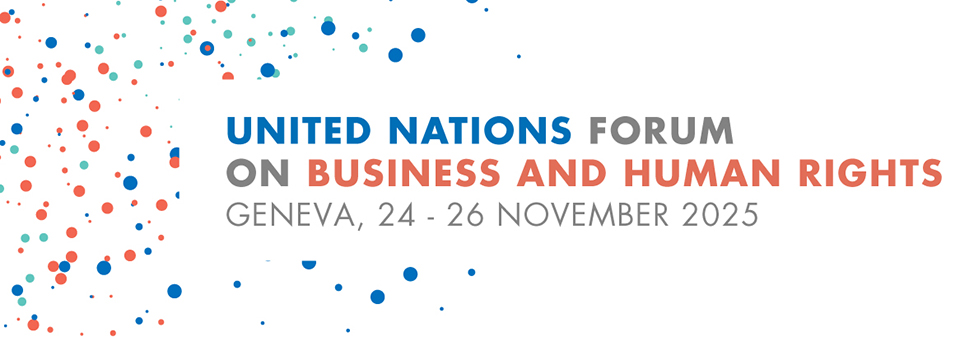
The 14th UN Forum on Business & Human Rights, the world's leading summit dedicated to promoting the UN Guiding Principles on Business and Human Rights, has just closed in Geneva. The Forum brought together governments, the private sector, civil society, and international organizations to accelerate action on human rights.
The Forum provided a unique opportunity for multi-stakeholder dialogue to assess the effectiveness of existing regulatory frameworks on human and labor rights and explore strategies to improve commitments and actions in response to constantly evolving global dynamics.
According to estimates, 75% of participants came from the business world, but there was a lack of representation from suppliers and workers, who are the real protagonists of the subject. Among the issues that emerged most strongly in the discussion were the living wage – to which most companies are already committed – the link between climate and human rights, and the risks and opportunities associated with the use of AI to accelerate due diligence processes.
The theme of the summit, “Accelerating action on business and human rights amidst crises and transformation,” reminds us that it is increasingly complex for business to strengthen and accelerate commitment to protecting and respecting human rights. Considering the today’s unpredictable and rapidly changing global geopolitical landscape, ensuring that governments and businesses respect human rights obligations and responsibilities requires resilience, adaptability, political will, and a greater commitment to action.
But in order to implement a real “just transition” all together, it is essential to keep People at the center, and in this regard, businesses have a crucial role and responsibility: as Volker Türk, the United Nations High Commissioner for Human Rights, also pointed out during the proceedings in Geneva, the cost of human rights abuses is not merely abstract. Protests, delays, and boycotts cause billions in financial losses.
The Italian Network of the UN Global Compact, with over 700 member companies, represents a privileged observatory on the dynamics of Corporate Human Rights Due Diligence and on the main critical issues that Italian companies encounter in the implementation of HRDD processes, such as:
- lack of internal awareness and understanding of the business case: companies find it difficult to spread a culture of human rights at all levels inside their organizations. According to the study “Human Rights vs Competitiveness: a False Dilemma” conducted by UNDP and the World Benchmarking Alliance on a sample of over 200 multinationals, robust human rights policies and processes do not reduce financial performance. Instead, they are correlated with greater asset efficiency and operational resilience, overturning the myth of the cost of compliance;
- lack of resources and skills, limited availability of dedicated corporate teams and specific know-how on the issues: it is important to understand which function within the company is responsible for due diligence and how to involve all the other impacted areas (sustainability/ CSR, HR, legal, compliance, procurement) in order to work at the level of internal task forces on shared action plans, in which all business units are included in the processes and in identifying the right stakeholders to involve. In this regard, the Italian Network of the UN Global Compact has launched the Business & Human Rights Accelerator, a six-month training course in which two company representatives from different functions can participate;
- complexity in monitoring suppliers and subcontractors, especially in high-risk countries: in this scenario, the adoption of supplier codes of conduct that also integrate human rights aspects should become more and more common. The UN Global Compact Network Italy Guidelines on how to develop a Supplier Code of Conduct include this fundamental component of the social dimension and instruct companies to comply with minimum standards recognized at the national, regional, and international levels and to respect the cultural, religious, economic, and social rights of local communities, minorities, indigenous peoples, and other vulnerable groups, taking into account the operating context and activities carried out;
- challenges in mapping stakeholders to be consulted in due diligence processes: difficulties in defining who to involve in consultations, especially in complex supply chains and when discussing impacts on local communities and rights holders, and in conducting meaningful stakeholder engagement. In addition to directly affected stakeholders, consultations should also involve credible proxies (e.g., trade unions) and human rights experts (e.g., NGOs). According to the UNGPs, consultation must respect four pillars and be timely and ongoing, informed, inclusive, and secure.
- difficulties to go beyond regulatory compliance, especially in the context of the current regulatory uncertainty in Europe: the European directive on corporate sustainability due diligence (CSDDD), celebrated last year as one of the most significant political achievements at the EU level in recent history, is undergoing profound limitations and revisions due to the recent approval of the Omnibus I;
- lack of attention to remedial measures: many companies focus on risk identification and prevention but neglect the third pillar of the UNGPs (remedy), leading to a gap in the management of violations and the effective protection of rights.
During the closing plenary session of the UN Forum on Business and Human Rights, Melissa Powell, Deputy Executive Director of the UN Global Compact, reiterated UNGC’s commitment to supporting companies of all types and sizes in promoting human rights in the workplace and gave three recommendations for each key stakeholder: Companies, Governments, and Civil Society.
Companies
- View human rights as a strategic governance issue, not just a reporting metric.
- Communicate with suppliers and deliver real progress, not just promises.
- Commit to doing your utmost, moving at the “speed of risk” not at the speed of perfection.
Governments
- Ensure policy consistency and create favorable conditions to promote responsible behavior by companies;
- Put in place real incentives to support responsible practices;
- Ensure that grievance mechanisms are aligned with the United Nations Guiding Principles on Business and Human Rights (UNGPS).
Civil society
- Continue to demand accountability for various actions and responsibilities and provide specific examples and evidence in defense of human rights.
- Continue to imagine new solutions based on the real experiences of workers.
- Collaborate with different actors in the search for joint solutions that can lead to real social justice.